Shimano Silent Assassin: Every Model Explained (80 to 160, Flash Boost vs Jet Boost)
minagiman
Minagiman's Fishing Adventures in Japan
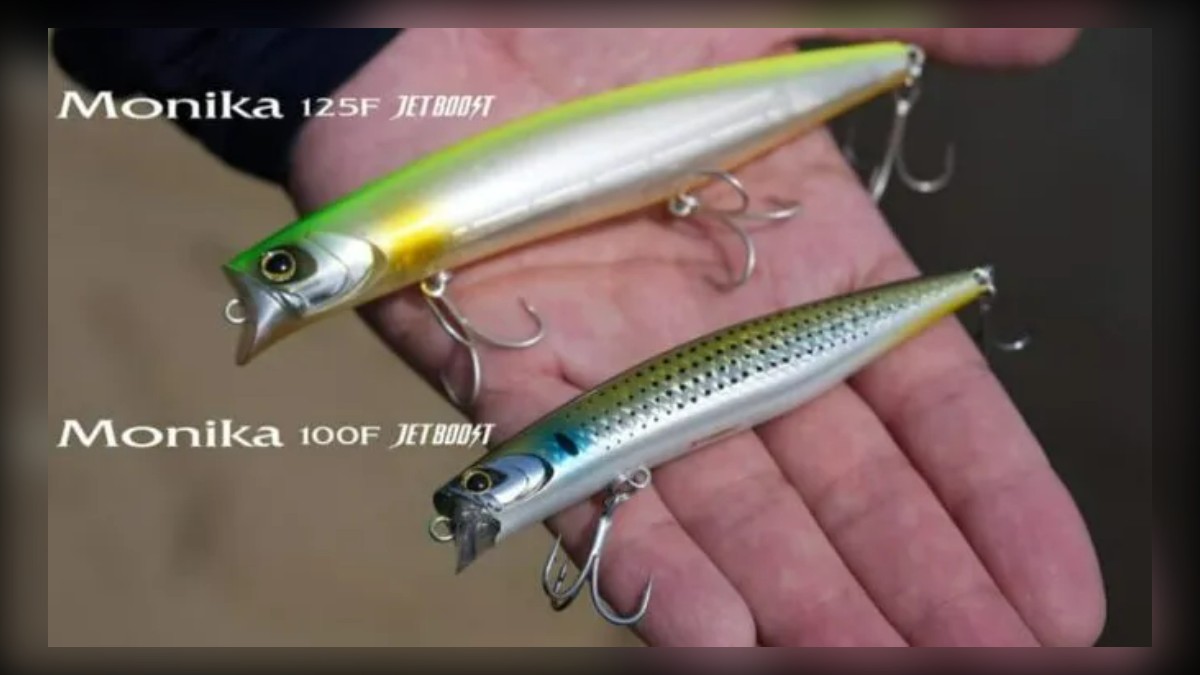
Shimano’s seabass shallow-runner Monica now comes one size smaller: the Monica 100F Jet Boost.
The 125F is popular for fishing from just under the surface down to about 30 cm. But there are times when 125 mm is too big – when the bait is small, or on small rivers. The 100F fills exactly that gap as a “bite-trigger” size. In early autumn the juvenile mullet (inakko) are often still small, so this size is welcome.
Here is how it differs from the 125F, and where it should work best.
| Type | Floating |
| Length | 100 mm |
| Weight | 11 g |
| Casting distance | 49 m |
| Running depth (reference) | To 0.15 m |
| Swimming angle | 5 degrees |
| Current rating | From 60 cm/sec |
| Hooks | #6 x 2 |
| List price | 2,000 yen (excl. tax) |
| Colours | 10 |
The key figure is the running depth: to 0.15 m, with the target range tuned to 0-10 cm below the surface. It is designed to get seabass that are looking at the surface to bite just under it.
| Monica 100F | Monica 125F | |
|---|---|---|
| Length | 100 mm | 125 mm |
| Weight | 11 g | 22 g |
| Casting distance | 49 m | 61 m |
| Running depth | To 0.15 m | To 0.3 m |
| Swimming angle | 5 degrees | 10 degrees |
| Current rating | From 60 cm/sec | From 66 cm/sec |
| Hooks | #6 x 2 | #4 x 3 |
| List price (excl. tax) | 2,000 yen | 2,250 yen |
It is 25 mm shorter and half the weight, and it swims even shallower than the 125F, at a flatter angle. It casts 12 m less, so the split is simple: 125F to cover distant water widely, 100F for precise near-to-mid-range spots.
The moving weight is Shimano’s familiar Jet Boost: the weight shifts back for a stable cast, then snaps forward on landing so the lure starts swimming immediately. Shimano tester Yasuo Kawakami names this fast start-up as what he likes most. On a small river, firing at a single boil, the first few turns after landing decide everything – and a fast start is a real advantage there.
The action is roll-dominant, built to look natural rather than flashy. Even in slack water or on a slow retrieve, it moves with a tight, crisp pitch. It holds its depth and swims tightly even when you are winding just enough to take up slack – which should suit seabass that are fixated on small bait and reluctant to bite.
The Monica series is built around drifting: casting to where seabass should be holding and letting the current carry the lure in. The 100F resists jumping out of the water not only on up-current casts but also on down-current casts facing straight into the flow. That means the whole retrieve, all the way to your feet, is a chance for a bite.
Its main stage. In narrow rivers, where you fire accurately at pin-point spots at close range, the 100 mm / 11 g size and fast start-up come into their own.
When juvenile mullet are still small, or sardine and gizzard-shad-type bait (sappa) are the main food – use it as a size-down when the 125 mm is not getting responses.
Single boils, bait sitting near the surface: seabass using the surface as a “wall” to trap bait are exactly what a lure running 0-10 cm deep is made for.
The two basic techniques are a slow-ish straight retrieve and a drift. No difficult rod work is needed, so it is easy to use even if you have never fished a shallow-runner.
At 11 g and 49 m, it is not suited to searching far out on a surf beach. At most, it is for river mouths on a calm day or close to the water’s edge. To fish just under the surface on a beach, heavier sinking pencils and minnows are more comfortable.
As an 11 g floating minnow, it is easiest on a seabass rod with a lower lure rating starting around 7 g. On small rivers, an easy-to-handle rod in the 8-foot range works well. Line: around PE 0.8-1.
In other words, it has one clear purpose: to get bites in shallow water at close-to-mid range, matched to small bait.
Ten colours: N Inakko, Pearl Chart, Multi Flash, N Holo RH, A Silhouette Black, T Clear Iwashi, Matt Blur Bait, Tomoshibi, Rame Nada and Night Special 2. A simple split: N Inakko for the mullet pattern, T Clear Iwashi for clear water and sardine, and A Silhouette Black or Pearl Chart at night or in stained water.
Anyone who already owns the 125F has probably wished for one a size smaller. It arrives in time for the autumn juvenile mullet pattern – worth a place in the box. (For the bigger picture, see Japanese seabass in autumn.)