Japanese PE Line Sizes Explained: gō Numbers, Leader Pairings and a Full Chart
minagiman
Minagiman's Fishing Adventures in Japan
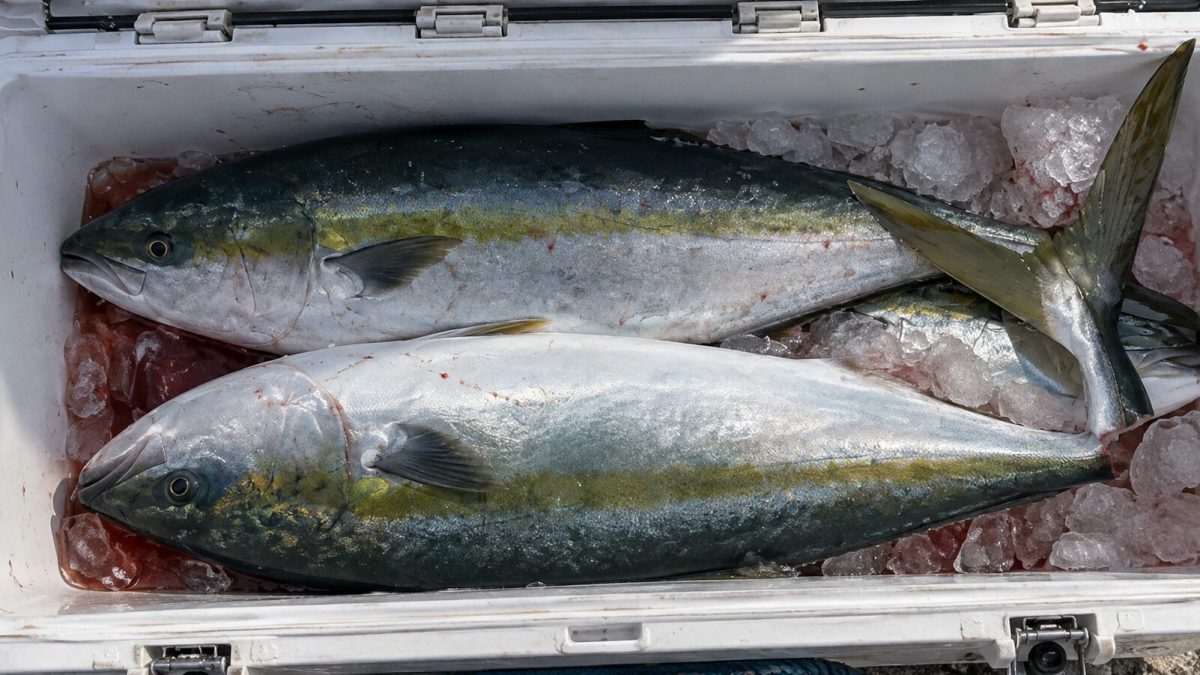
Catching a yellowtail from the beach is the easy part. Whether it tastes good is decided in the ten minutes after it hits the sand.
A fish left to thrash in a cooler heats up, its blood spreads through the flesh and it ends up with the metallic, “bloody” taste that makes people think beach-caught fish are second-rate. They are not. With a short routine, a surf-caught yellowtail makes sashimi as good as anything in a Japanese fish market. This is that routine, adapted to the one thing a beach does not give you: a bench, a bucket and a big cooler.
| Step | What you do | Why |
|---|---|---|
| 1. Spike (nō-jime) | Kill it instantly with a spike to the brain | Stops it thrashing, which heats the flesh and builds lactic acid |
| 2. Bleed (chinuki) | Cut the gill roots and let it bleed in seawater | Blood is the source of the fishy, metallic taste |
| 3. Nerve kill (shinkei-jime) – optional | Run a wire down the spinal cord | Delays rigor mortis, so the fish stays fresh for longer |
| 4. Chill (kōri-jime) | Into an ice-and-seawater slurry | Gets the core temperature down fast. This is where the biggest difference is made |
Step 3 takes practice. If you are new to this, do 1, 2 and 4 and skip 3. In fact, doing 1, 2 and 4 properly beats doing 1 and 2 perfectly and chilling badly.
The whole process is what people outside Japan usually call ikejime. In Japan the word is used more loosely, and the individual steps have their own names, which is why I have included them.
Throw a live yellowtail straight into a cooler and it keeps fighting inside. While it does, its body temperature rises, lactic acid builds in the muscle, and the flesh goes soft and loses flavour. So the first job is to stop it moving.
On a yellowtail, the brain sits just above and slightly behind the eye, roughly where a line from the eye meets the extension of the lateral line. Push the tip of a spike or knife in there once, firmly. When you hit it, the fish stiffens for an instant, the mouth and fins flare open, and it goes still.
Do this straight after the spike. Blood drains best while the heart is still beating, so do not leave a gap between steps 1 and 2.
A bucket of seawater is the reliable way. On a beach, simply holding the fish in the wash at the water’s edge also works – but secure it with a rope or stringer, and stand where the next wave will not take it, or you.
After the brain spike, a special wire is fed through the hole in the head and down the channel above the spine, destroying the spinal cord. Stopping the stray nerve signals after death delays the onset of rigor mortis.
It matters most if you want to eat the fish as sashimi the next day or later, or you have a long drive home. If you are eating it the same day, steps 1, 2 and 4 already make a clear difference. Get those reliable first, then add this.
Spike and bleed a fish perfectly, chill it slowly, and you have wasted most of the effort. Autumn days on the beach are still warm, and the inside of a cooler heats up.
A fish lying on plain ice only cools where it touches the ice. Add seawater and the fish is surrounded by ice-cold water, which pulls the heat out of the whole body, right to the core. In Japan this is called shio-kōri, “salt ice”.
If you walk a beach covering water, a big cooler is not coming with you. There are really only two options:
| Style | How | Suits |
|---|---|---|
| Car close by | Leave the cooler in the car and walk back to process each fish | Short walks from the car park |
| Walking the beach | Keep the fish in a small soft cooler or on a stringer, and get it to the car often | Anglers covering a lot of sand |
A proper buri will not fit in most coolers. The usual answers:
Dumping guts at the fishing spot is bad manners and is prohibited at many beaches. Bag it and take it home.
In yellowtail and many other fish, the parasite Anisakis lives mainly in the gut. It is known to move from the gut into the flesh as time passes after death, so removing the guts early is the basic way to reduce that.
Anisakis is killed by cooking (60°C for at least one minute) or freezing (-20°C for at least 24 hours). If you are eating the fish raw, check the flesh carefully by eye when you fillet it.
| Mistake | What happens | Fix |
|---|---|---|
| Straight into the cooler, alive | It thrashes, heats up, soft flesh, poor flavour | Spike it first |
| Skipping the bleed | Bloody, fishy smell when you fillet it | Cut the gills, hold it in seawater |
| Chilling on ice alone | Only the surface cools, the core stays warm | Add seawater to make a slurry |
| Ice directly on the flesh | Pale ice-burn patches | Wrap in newspaper or plastic |
| Chilling in fresh water | Watery flesh | Seawater only |
| Leaving it ungutted for hours | Higher anisakis risk in the flesh | Gut it early |
As a general rule, it is firm on the day and gains flavour from the next day on. But resting a fish that was badly bled and badly chilled only makes it worse. Get the handling right first.
The opposite. Unhook it quickly, do not hold it in your hands for long, and get it back in the water. Leaving a fish you intend to release on dry sand damages the protective slime on its skin.
The same basic sequence. Ribbonfish have extremely sharp teeth, so be very careful how you hold them. Flounder struggle less than yellowtail, so careful bleeding and chilling alone make a big difference.